
What Tycoon mode means
Tycoon mode is the business-focused way to play Transport Fever 3. You build a company by connecting passenger and freight demand, while keeping the cost of vehicles and infrastructure in view. The official store description frames the challenge as a balance: deliveries earn money, each vehicle adds costs, and towns and industries continue to present evolving needs.
That means Tycoon is not simply a construction mode with a balance sheet attached. A route has to perform a useful service, and the service has to justify the resources it consumes. A network may be large yet financially weak if it covers places without sufficient demand; a small route may be more valuable if it reliably solves a clear connection problem. Those are planning principles, not guaranteed outcomes—the game’s map, era, difficulty, and live demand all matter.
Income, vehicles, and infrastructure costs
Every expansion has more than one cost. New track or road requires investment, and the vehicles using it add ongoing expense. Official descriptions explicitly call out fleet management, maintenance, efficiency, and priorities. As a result, the useful question is not only “Can I connect these places?” but also “What does this connection need to deliver, and what must I operate to deliver it?”
When reviewing a struggling route, separate the symptoms. Is the service failing to reach the demand? Is cargo delayed at loading or a transfer? Is the fleet larger or more expensive than the service requires? Is a physical bottleneck causing traffic or wait times? Changing one variable at a time makes the financial effect easier to understand.
Loans and contracts add another decision layer. The game advertises a dynamic loan and contract system with risk-versus-reward opportunities. Because obligations and terms can matter, read the live offer in your game before accepting it; this page does not presume a universal contract or loan strategy.
Meet changing town and industry demand
Cities and industries do not remain static endpoints. The game describes dynamic towns, individual inhabitants, evolving demands, and more than 35 industries, including offshore sectors. A route that once served a town well may need capacity, access, or a different transfer as the place and network develop.
For passengers, use the current town information to understand where people are traveling and how well the service connects them. For freight, trace the complete chain: requested goods, production inputs, loading points, transfers, and destination. Official cargo material describes more direct player control over loading and unloading, plus warehouses and specialized terminals for intermediate storage. Those systems can give you useful options, but inspect the actual problem before investing in a larger facility.
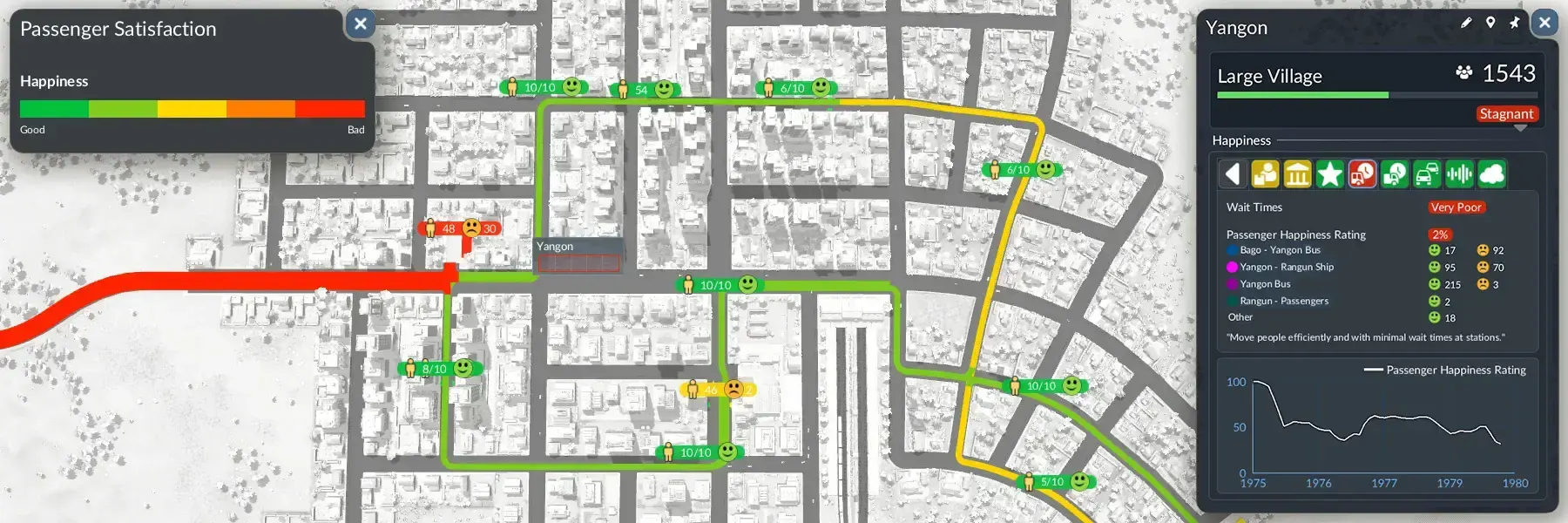
The game also surfaces effects beyond revenue. Its official Tycoon overview discusses traffic, pollution, noise, satisfaction, and city needs. A service can therefore affect both the company and the place it serves. Treat these indicators as diagnostic evidence: identify which factor is deteriorating before adding capacity or building another line.
Company progress and rewards
Official Tycoon material describes company rankings, bonuses, and landmarks. Urban Games says rank progression is connected to population growth, with benefits and landmark access forming part of the broader progression. This gives long-term goals a connection to how the company serves towns, rather than making growth only a matter of laying more track.
Landmarks also connect progression back to logistics. The official game overview describes world-famous landmarks as achievements, while other official materials say some landmarks require dedicated logistics chains. Check the specific requirement in-game; the available evidence does not establish one universal unlock route for every landmark.
Choose your challenge
Transport Fever 3 advertises highly adjustable difficulty. The store description says settings can change how the world, economy, and citizens react, from demanding management to a more relaxed experience. Tycoon is therefore not defined by a single fixed settings preset in the sources currently available.
If you are learning the economic systems, pick a manageable challenge and pay attention to how routes behave before making large commitments. If you want a tougher business problem, increase pressure only when you know which systems you want to test. If your goal is mostly architectural, Sandbox can reduce or remove economic pressure; use Tycoon when the financial loop itself is part of the fun.
A practical management loop
Use this sequence to make an expansion easier to evaluate:
- Name the need. Identify the passenger trip, cargo delivery, or town problem you intend to solve.
- Trace the service. Map every stop, transfer, industry, and destination before building.
- Estimate the commitment. Consider required infrastructure, vehicles, maintenance, and loading capacity.
- Start with a testable route. Avoid expanding several connected systems at once if you do not yet know where demand is.
- Inspect the result. Check delivery, usage, costs, queues, traffic, and the affected town indicators.
- Adjust the cause. Change the part tied to the clearest bottleneck, then observe again.
This is a way to reason about decisions, not a claim that every route becomes profitable. For the broader transport systems behind those decisions, read the gameplay overview. New players may want to start with the Beginner Guide before taking on a stricter management challenge.

See how gameplay systems connect
Follow passenger demand, freight logistics, vehicles, and infrastructure as one network-planning problem.
Read guide →These details follow the currently published official Tycoon overview and Steam feature description. Use the settings and live information shown in your own game when making a specific financial decision.